You Get What You Inspect, Not What You Expect
Getting things done in Costa Rica is rarely about pressure or expectations. It’s about presence, follow-up, and respect. This article explains why inspection works, impatience backfires, and kindness often gets the best results.
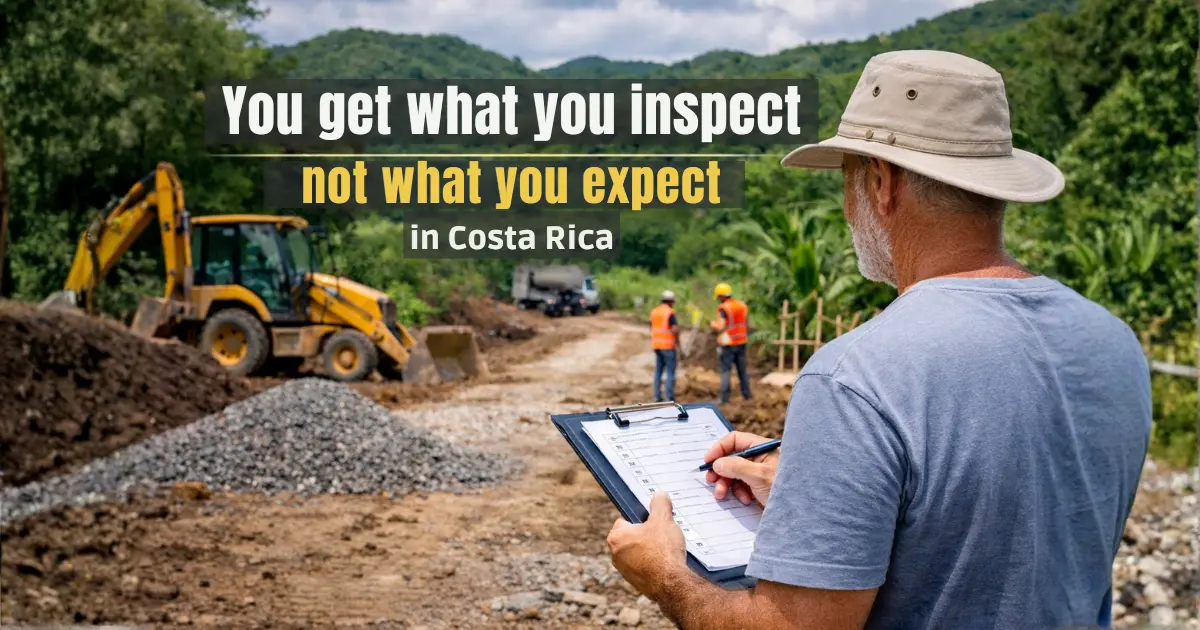
This article is dedicated to Jim and Betty, who patiently—and persistently—set out to improve a road on their property in Costa Rica.
Anyone who has tried to get work done in Costa Rica learns this lesson quickly.
The machinery arrives late.
The materials are promised, then postponed.
The rain intervenes.
A phone call goes unanswered.
None of this is malicious. None of it is unusual. And none of it means the project is failing.
It simply means the work requires attention.
Living or doing business in Costa Rica teaches a quiet but powerful lesson—often the hard way.
Things do not fail because people are dishonest or incapable. They fail because expectations are assumed instead of verified.
Costa Rica is not a country where systems run themselves. It is a country where systems run with human attention.
That difference matters.
Expectation vs. Inspection
Many newcomers arrive with an unspoken belief:
“If I’ve explained it clearly, it should happen.”
In Costa Rica, clarity is only the starting point.
What actually moves things forward is inspection:
- Checking that a request was received
- Confirming that it was understood
- Verifying that the next step happened
- Following up when it did not
This is not micromanagement. It is participation.
Get clear, practical insights on life and business in Costa Rica.
Join our free weekly newsletter — ad-free, spam-free, and trusted by expats, investors, and retirees across Costa Rica.
Why This Is Not a Cultural Flaw
This dynamic is typically misunderstood as inefficiency or lack of professionalism. In reality, it reflects how responsibility is distributed.
Costa Rican systems are relationship-driven and task-flexible. Deadlines are real, but they are rarely self-executing. Files move when someone is paying attention to them.
If no one is watching, many things simply wait.
That does not mean people are lazy. It means initiative matters more than assumption.
Why Pressure and Anger Backfire
This is where many foreigners make things worse without realizing it.
In Costa Rica, treating workers badly does not speed things up. It usually slows them down—or stops them entirely.
Raising your voice, issuing ultimatums, or expressing frustration may feel productive. Here, it is frequently counterproductive.
Costa Rica is a small country. People remember how they are treated. Word travels quietly, but it travels.
Kindness, on the other hand, works.
A respectful tone.
A calm follow-up.
A genuine “thank you.”
These things build cooperation far more effectively than pressure ever will.
Inspection works best when it is paired with respect.
Where Expats Get Stuck
Foreigners struggle most when they rely on:
- Verbal confirmations
- “Don’t worry, it’s taken care of”
- Silence being interpreted as progress
Silence seldom means progress.
Silence usually means:
- The task is pending
- The file is incomplete
- Someone is waiting for something else
- Or it has slipped down the priority list
Inspection is what brings it back up.
Inspection Is Not Confrontation
One of the biggest mistakes expats make is avoiding follow-up because they don’t want to seem rude, pushy, or distrustful.
In Costa Rica, polite follow-up is not offensive. It is expected.
A short message.
A calm check-in.
A request for confirmation.
These are signs of engagement, not suspicion.
Expert guidance for expats in Costa Rica.
Join our free weekly updates—practical, ad-free, and easy to read.
What Inspection Looks Like in Practice
Inspection does not mean hovering. It means structure.
Effective inspection includes:
- Written summaries after meetings
- Clear next steps with names attached
- Specific dates, even if flexible
- Periodic check-ins rather than long silences
People respond far better to gentle consistency than to sudden urgency.
The Payoff
When you inspect instead of expect:
- Permits get issued
- Repairs actually happen
- Paperwork moves forward
- Deadlines become more predictable
You stop feeling frustrated and start feeling informed.
And most importantly, you stop blaming the system—and start working with it.
A Different Kind of Productivity
Costa Rica does not reward impatience.
It rewards presence.
Those who succeed here are not the loudest or the most demanding. They are the ones who stay engaged, treat people well, and follow through until the job is done.
In the end, Jim and Betty got their road done. When the work was finished, they took the crew to a local lunch to say thank you. Before parting ways, they gave each worker a new machete—a practical gift, offered quietly, for a job well done.
Expectation is passive.
Inspection is active.
And in Costa Rica, activity—paired with respect—is what produces results.
Need Help? Talk to a trusted professional or contact us for a quick reply.