
Driving in Costa Rica: Know the Rules for Expats.
Driving in Costa Rica is legal for expats when your immigration status is current and your documents are in order. This guide explains licenses, visas, ATVs, border runs, and common mistakes—clearly and accurately.
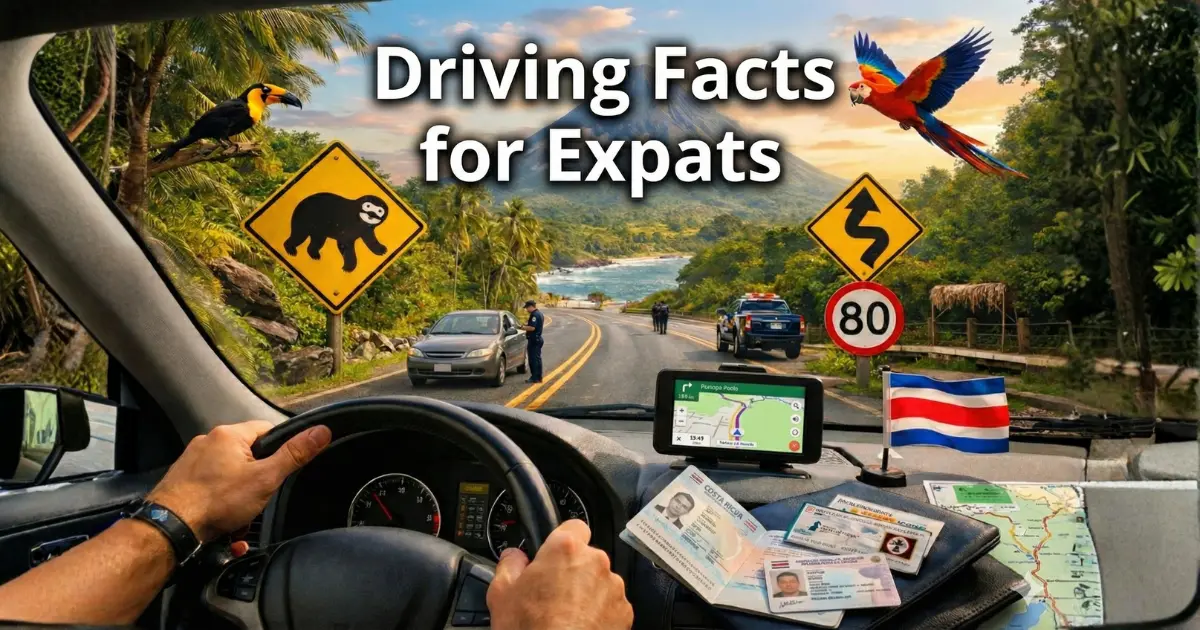
Driving in Costa Rica is straightforward once you understand how the rules are written—and how they are enforced in practice. The system places strong emphasis on legal immigration status, proper documentation, and personal responsibility.
This guide explains the current rules clearly, focusing on what works in real life so expats, retirees, and long-term visitors can drive legally and avoid unnecessary risk.
Foreign Driver’s Licenses in Costa Rica
Costa Rica allows foreigners to drive using a valid foreign driver’s license, but only while their immigration status is clearly valid and provable.
How the rule works in practice
- Your right to drive is tied to your passport entry stamp
- When the stamped period expires, your right to drive on a foreign license is generally considered expired
- Driving privileges reset only if immigration grants a new legal stay
At roadside stops, police check your license and passport together.
Minimum Age and Vehicle Types
- Minimum driving age: 18
- Foreign drivers may operate:
- Cars
- SUVs
- Pickup trucks
- Motorcycles
- ATVs (cuadraciclos), under specific conditions
Commercial and heavy vehicles require Costa Rican license classes and are not covered by tourist or expat driving privileges.
Documents You Must Carry
Costa Rican enforcement remains document-focused.
Foreign drivers should carry:
- Passport (original)
- Foreign driver’s license (physical)
- Vehicle registration (marchamo)
- Proof of insurance
Digital images on a phone may be insufficient, especially for verifying passport entry stamps.
Get clear, practical insights on life and business in Costa Rica.
Join our free weekly newsletter — ad-free, spam-free, and trusted by expats, investors, and retirees across Costa Rica.
Insurance Requirements
All vehicles must carry mandatory liability insurance (Seguro Obligatorio Automotor – SOA).
- Rental vehicles include it automatically
- Privately owned vehicles must be current
- Optional comprehensive coverage is strongly recommended
After accidents, vehicles may be impounded until liability is determined.
Speed Limits and Enforcement
Speed limits are posted and enforced but change frequently.
Typical limits:
- Highways: 80–100 km/h
- Secondary roads: 40–60 km/h
- Towns and residential areas: 25–40 km/h
Police checkpoints and speed cameras are common. Fines are significant.
Alcohol and Driving
Costa Rica applies strict alcohol enforcement.
Even low levels can result in penalties, and higher levels may lead to:
- Heavy fines
- License suspension
- Vehicle seizure
The safest rule remains simple: do not drink and drive.
Road Culture and Right of Way
Driving culture rewards patience and defensive habits.
- Pedestrians have strong legal protections
- Motorcycles frequently filter between lanes
- Turn signals are common but not guaranteed
- Road conditions vary widely, especially in rainy season
Calm, predictable driving reduces risk.
What To Do After an Accident
If you are involved in an accident:
- If there are injuries or disagreement, do not move the vehicles
- Call 911 and wait for police and insurance representatives
Minor accidents (DAM system)
Costa Rica now allows the Declaración de Accidente Menor (DAM) when:
- There are no injuries
- Both parties agree on responsibility
In those cases, vehicles may be moved to clear traffic.
Practical guidance for expats:
If you are unsure of the language, liability, or process, waiting for police remains the safest approach to avoid later disputes.
FAQ: Does a 180-Day Visa Allow You to Drive for 180 Days?
Yes.
Costa Rican traffic law authorizes foreign drivers to operate vehicles for the same number of days granted by immigration.
If immigration grants:
- 180 days → you may drive 180 days
- 90 days → you may drive 90 days
- 30 days → you may drive 30 days
Your foreign license must be valid, and you must not overstay.
Bottom line: Driving time matches the passport stamp.
Expert guidance for expats in Costa Rica.
Join our free weekly updates—practical, ad-free, and easy to read.
FAQ: Does Leaving Costa Rica and Re-Entering Reset Your Right to Drive?
Only if immigration grants a new legal stay.
Leaving Costa Rica does not guarantee a new 180-day stamp. Driving privileges reset only for the number of days shown on the new entry stamp.
FAQ: Can Someone With Residency in Process (Trámite) Drive?
This is where many expats make a dangerous assumption.
A properly filed residency application (trámite) can allow you to remain legally in Costa Rica, but traffic police do not consistently treat trámite paperwork as extending your ability to drive on a foreign license once your passport entry stamp expires.
In practice:
- A trámite document often has no clear expiration date
- Roadside enforcement relies heavily on the passport entry stamp
- Once the stamped period expires, driving on a foreign license becomes risky
The safer path: Use trámite to start homologation (and plan for DIMEX)
Recent changes and current practice mean that, in many cases, a person with residency in process can begin the homologation (conversion) process at COSEVI using proof that the application was formally filed and assigned an expediente (file) number.
However, procedures vary by COSEVI office, and many offices still require the physical DIMEX card to finalize homologation and issue the Costa Rican driver’s license.
What this means for expats
- Do not rely on trámite alone to keep driving on a foreign license after your passport stamp expires
- Use your expediente number to prepare and begin the COSEVI process as early as possible
- Expect that you may need the DIMEX to complete issuance of the license
- Confirm the current requirement directly with COSEVI for your appointment location
Best practice:
Treat trámite as a bridge to get compliant—not as a substitute for a Costa Rican license once your stamp expires.
FAQ: Can an Expat Drive an ATV (Cuadraciclo) Legally?
Yes—but ATVs are treated as motor vehicles, not recreational toys.
Under Costa Rican traffic law:
- ATVs (cuadraciclos) are expressly recognized
- Foreign drivers may operate them during a valid legal stay
- Engine displacement must not exceed 500 cc
- A valid driver’s license is required
- The ATV must be registered, insured, and current on marchamo
Driving unregistered rental ATVs, especially on beaches, is one of the most common violations.
Common Driving Mistakes Expats Make
- In Costa Rica, your right to drive is not controlled by your license expiration date.
- Ignoring passport visa stamps
- Relying on digital documents
- Moving vehicles improperly after accidents
- Underestimating alcohol enforcement
- Treating border runs as guaranteed resets
Final Takeaway
Driving in Costa Rica works best when approached conservatively: clear immigration status, physical documents, and respect for local enforcement realities.
When in doubt, choose the option that reduces exposure—not the one that tests interpretation.
Need help understanding residency, license conversion, or compliance rules in Costa Rica? We help you protect and understand Costa Rica’s systems—clear, factual, and practical.
Free Download for Members: