
Declare It or Pay MORE: Costa Rica Property Taxes
Your Costa Rica property tax is based on the declared value you report to your municipalidad. Filing your declaración de bienes inmuebles on time keeps your tax fair, prevents fines, and stops the municipality from overvaluing your property.
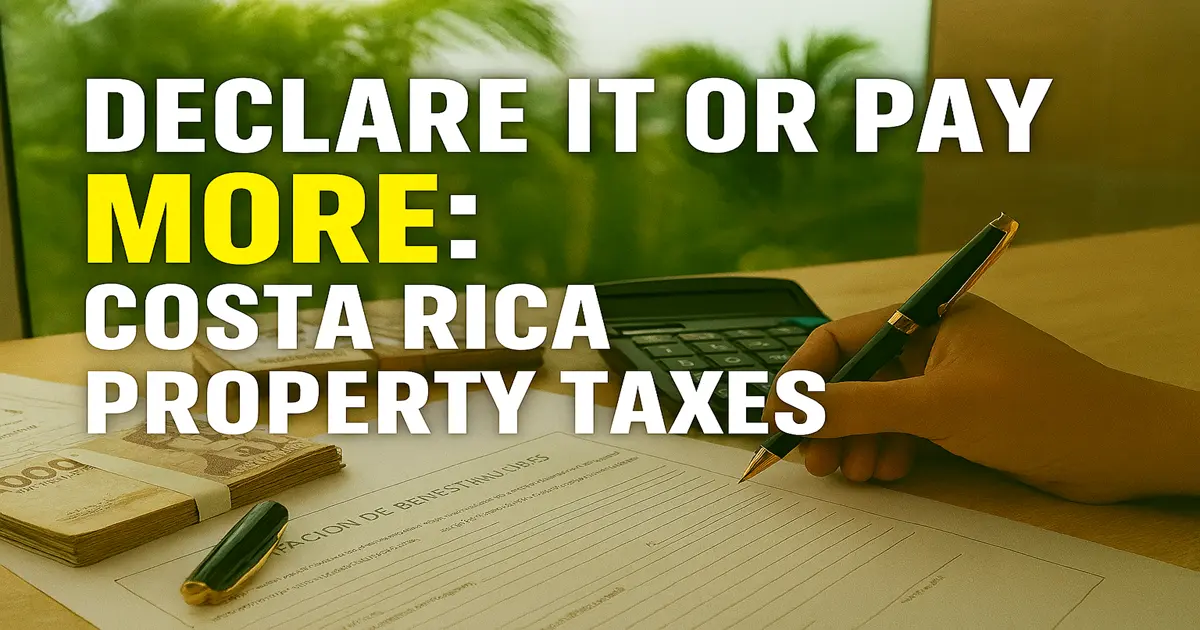
Owning property in Costa Rica comes with one recurring responsibility that many expats and investors overlook: filing the property value declaration (declaración de bienes inmuebles). This single document decides how much you pay in municipal property taxes and whether your rate stays steady—or suddenly rises.
The Foundation of Costa Rica Property Taxes
Under Law 7509, every property owner owes an annual property tax (impuesto sobre bienes inmuebles) equal to 0.25 % of the declared value. That value isn’t automatic—it’s based on the information you submit to your municipalidad.
Filing your declaration gives you control over the assessed value used for taxation. If you fail to file, the municipality may assign its own value—often higher than what you would have declared.
How Often to File
Property owners must file a new declaration every five years, or sooner if major improvements, construction, or subdivision occur.
Some municipalities require an annual confirmation (ratificación anual) stating that no changes have occurred. If you don’t file, your local government can estimate the property’s value using comparable sales or outdated assessments—and your tax bill can climb sharply.
Risks of Ignoring the Declaration
Failing to keep your declaración de bienes inmuebles current can result in:
- Higher assessed value: Municipal staff may assign a market-based figure that inflates your taxes.
- Interest and fines: Unpaid taxes accumulate about 1.5 % interest monthly in many cantons.
- Judicial collection: Persistent nonpayment can lead to cobro judicial, where the municipality files a lien or foreclosure action.
- Administrative delays: You may be unable to sell property, obtain permits, or renew business licenses without proof of compliance.
Why Staying Current Protects You
- Control your valuation—A precise declaration keeps your property’s fiscal value realistic.
- Predictable tax bills—Avoid sudden jumps caused by reassessments.
- No penalties—Timely filing prevents fines and interest charges.
- Preserve exemptions—Agricultural or residential discounts depend on updated declarations.
- Simplify transactions—Accurate records make sales, fideicomisos, and estate transfers smoother.
What You Need to File
- Número de finca (property ID)
- Plano catastrado (cadastral map)
- Description of buildings or recent improvements
- Owner identification (individual or corporation)
- Optional: professional appraisal or engineer’s report
You can usually download the Declaración de Bienes Inmuebles form from your municipal website or file it in person. Many municipalities now accept digital submissions prepared by an engineer or certified public accountant (contador público autorizado).
Example: How the Numbers Add Up (using 500 CRC/1 USD)
If your property’s declared value is ₡100 million (≈ $200,000 USD), your yearly municipal tax is ₡250,000 (≈ $500 USD). If the municipality revalues it at ₡150 million (≈ $300,000 USD) because your declaration expired, the annual tax rises to ₡375,000 (≈ $750 USD)—and you may owe retroactive interest.
A short filing every few years can prevent years of inflated payments.
Final Word
Your municipal declaration isn’t just another piece of paperwork—it’s the foundation of how your property is taxed in Costa Rica. Filing it correctly and on time protects your investment, prevents overvaluation, and keeps you compliant with your local municipalidad.
If you’re unsure whether your declaration is current or how to correct an outdated filing, professional guidance can save you both time and money.
Whether you live in Costa Rica year-round or manage property from abroad, take this one simple rule to heart: declare it—or pay more.
Need Help? Talk to a trusted professional or contact us for a quick reply.